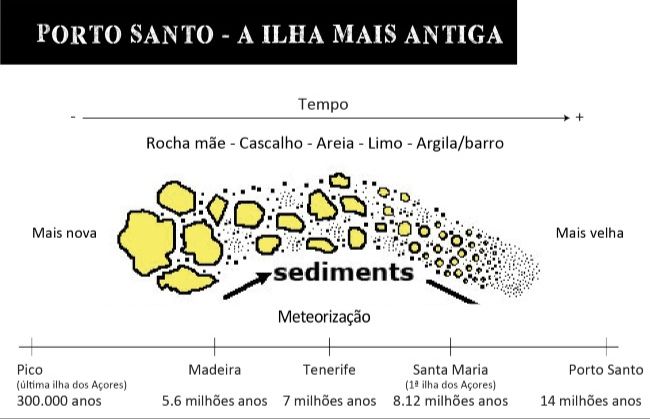
The island of Porto Santo emerged 14 million years ago in the Atlantic Ocean and is geologically one of the oldest islands in the Portuguese archipelagos. It was also the first to be discovered by Zarco in 1418. The Madeira Archipelago is 1,000 km southwest of mainland Portugal, at the same latitude as Casablanca.
With its temperate, oceanic climate, Porto Santo is Portugal's most arid island, with as little rain as the southern interior of mainland Portugal (Alentejo). The average temperature is also higher compared to Funchal (not the average for the whole of Madeira) and the Canary Islands. These differences in relation to the other Portuguese islands are due to the lack of a considerable peak or mountain. Considering Pico and Madeira, both have elevations with a maximum altitude of 2351m and 1861m, which lead to the formation of clouds and a consequent increase in rainfall.
The island of Porto Santo also has very different soils to Pico and Madeira. Compared to the other Portuguese islands, Porto Santo is almost twice as old as Santa Maria, the second oldest at 8 million years. If Pico, the youngest island, has stony soils, "mother rock", in Porto Santo the sediments have been weathered, making the soils sandstone. Porto Santo was formed by the deposition of sediments and limestone fragments of marine origin (algae, shells, bones, etc.). Interestingly, what other limestone soils of marine origin are already famous for producing excellent wines? Burgundy, Champagne and Jerez. António Maçanita couldn't pass up the opportunity to explore this potential.
The ancients used to say that Porto Santo was where they used to pick the ripest grapes to make the wine that made these islands famous. Today there are less than 14 hectares left, cultivated by a handful of hardy people. On the neighboring island they call the people of Porto Santo "Prophets", an old nickname that has never made so much sense when you see these old vines.
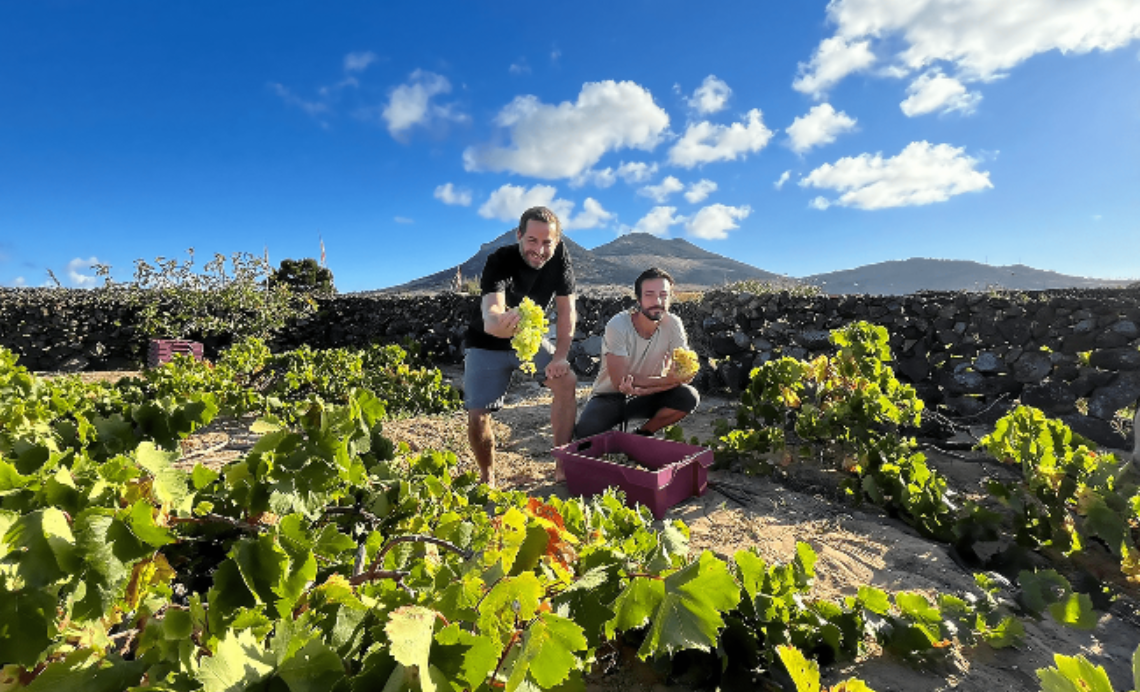
The vines are cultivated in a creeping manner, protected from the wind and sea air by crocheted walls or skillful reed structures. In other words, stone walls, just like viticulture in the Azores (the stones are light in Porto Santo and dark in the Azores), the Canaries and Santorini; while the reed beds are similar to those in Colares. Small stakes are used to lift the branches and prevent the bunches from touching the ground, as the hot sands would cook the grapes.
The traditional grape varieties on the island of Porto Santo are also unique and different from the rest of the Portuguese islands: Listrão, known on the mainland as Malvasia Rei, in the Canary Islands as Listan Blanco and in Jerez as Palomino Fino, has already proved its versatility in these regions, creating wines of excellence: from the renowned whites of the Canary Islands to the sherries of Jerez.
The origin of the Caracol grape variety is still uncertain, but there are already several stories and theories about the origin of its name. Genetically, we know that it is a close relative of the Listrão grape variety, being either a relative or a descendant.
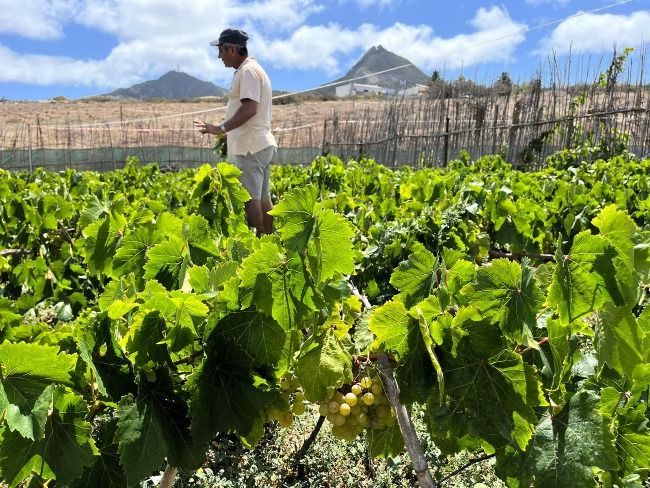
The total area of Madeira Island's wine-growing region is around 500 hectares. It is a unique landscape and is characterized by its volcanic soils, mostly basaltic, and its proximity to the sea. The terrain has very steep slopes, overcome by terraces.
The most traditional vineyard management system is the "latada" (pergola), in which the vines are managed horizontally.
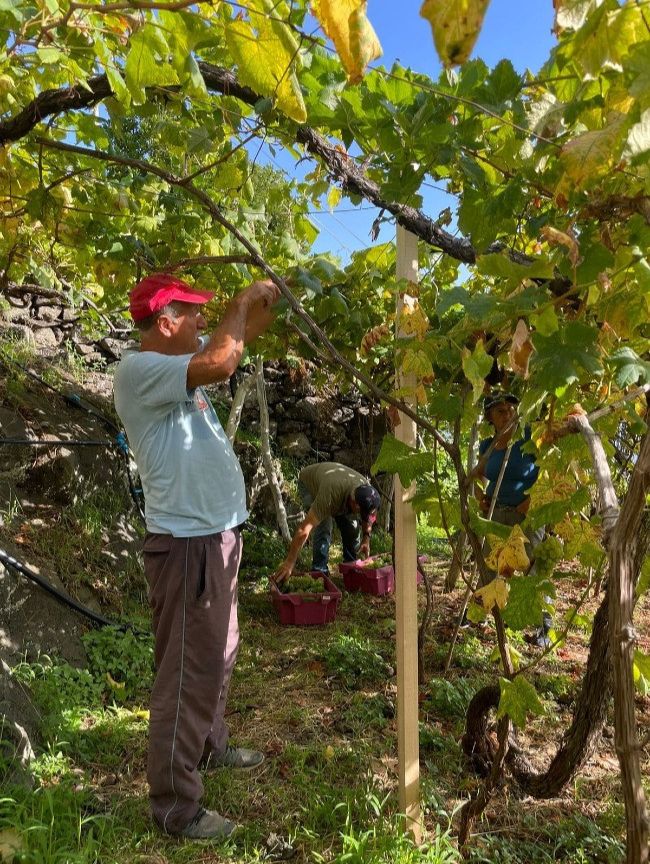
The Caracol grape variety is one of the traditional varieties on the island of Porto Santo. There are various stories and myths about its potential origin, such as that it was a Mr. Caracol who brought it here and planted it. António Maçanita's insatiable curiosity led him to analyze the microsatellites, which show its enormous genetic proximity to the Listrão, differing by only 1 out of a total of 20, and it may have the same parent or be the parent of one of the other. Regarding the name, research into old bibliography may also provide the reason for the name Caracol. Gaspar Frutuoso, in 1580, said: "There are many vineyards that give good grapes; many white snails are bred in them, in such a way that, in parts, they cover the bunch of grapes so much that no berry appears".
The Listrão grape variety is grown on the island of Madeira, as well as in the Canary Islands, Jerez and mainland Portugal. It is believed that the Listrão grape variety was introduced to the island of Madeira around the 15th century by Portuguese navigators returning from their voyages to the African continent.
The Tinta Negra variety is a very versatile and resistant red grape that is widely grown on Madeira Island. It originated in the Iberian Peninsula and was brought to Madeira in the 18th century, where it became the most widely planted grape variety on the island. Madeira's climate is hot and humid, with hot, dry summers and mild, rainy winters. The Tinta Negra variety adapts very well to this climate, as it is resistant to disease and has a good ability to adapt to different climatic conditions. It likes to be "by the sea" and in the Azores it is known as Saborinho and Molar in Colares, Sintra.
Related articles
Douro Top to Bottom: does the altitude of the vineyards influence the wine?